

As a naturally curious person, one of my favorite things about reading historical fiction is taking notes on things that I want to learn more about later. That was my experience reading Kayla Hardy’s debut novel, The Quarter Queen, which would also be considered historical fantasy.
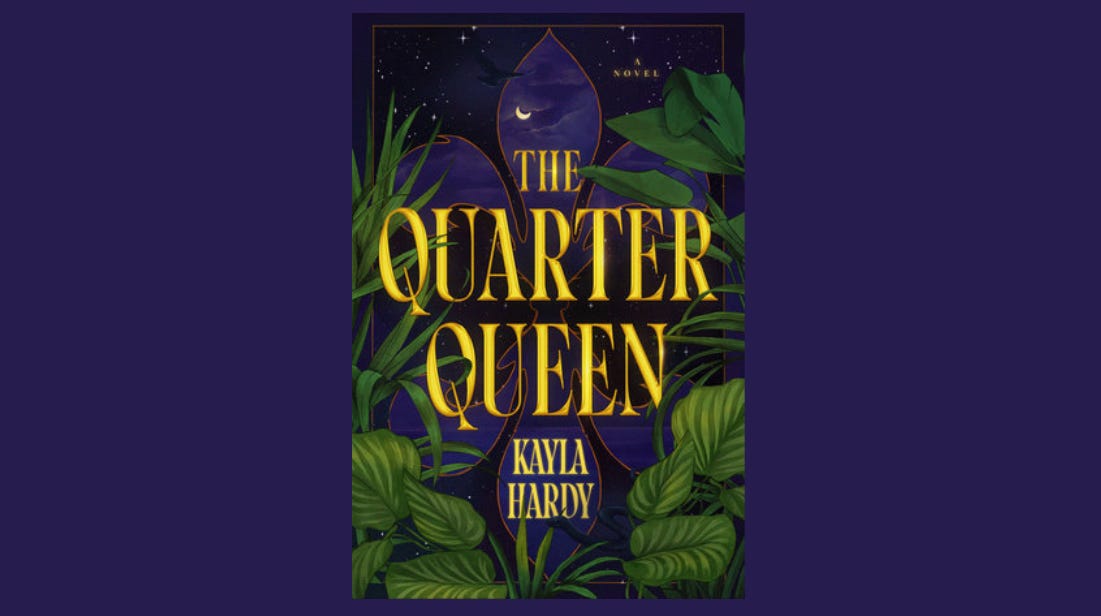
Described as Sinners meets The Witcher, the novel follows the legendary Voodoo Queen of New Orleans, Marie Laveau, and her daughter, Marie Laveau II (Ree), in 19th-century New Orleans. The book explores many different topics through the lens of the mother/daughter relationship.
Here’s how Kayla describes the book:
It’s been pitched as Sinners meets The Witcher, or Sinners meets Game of Thrones. It’s an epic Southern Gothic fantasy set in New Orleans, where Marie Laveau is cursed by her ex-lover and teacher, John the Conjurer, leaving only her daughter to step up. Ree is a bit of a brat with a heart of gold who’d rather be doing anything else. Still, she has to save her mother, maybe herself, and possibly the soul of the city, while navigating the politics of a nineteenth-century, magically divided New Orleans, and maybe become the next Quarter Queen herself.
At its core, it’s a tender mother-daughter story wrapped inside a politically fraught Witcher-style world. I grew up on those fantasies, and to me, historical fiction should say something about today. We clearly didn’t learn the lesson the first time around. You can talk about race, colorism, and futurism through a fantasy lens. New Orleans already has all of these tensions built in; I’m just heightening them slightly. I didn’t have to invent much.
Before reading the book, I knew very little about Marie Laveau, and even less about Voodoo, since my only exposure had been through movies like Eve’s Bayou, but honey, this book was so good and kept me intrigued all the way to the very end.
I had so many notes, thoughts, and questions after reading this book. Two of the questions that I kept coming back to are, first, what are some of the ways Hollywood has negatively shaped how we think of Voodoo, and secondly, what happens when we reclaim the stories we’ve been taught to misunderstand, which I think Kayla was able to do with this book.
I had a chance to speak with her about the novel, and I asked her those two questions, to which she said:
I think the media gets it wrong by painting it as satanic, all chicken bones and skulls and voodoo dolls, when the spiritual practice itself lines up closely with Catholicism. A lot of practitioners are both, and Marie Laveau was both, and saw no conflict there. In voodoo we have the Loa, which some people call gods, and Quarter Queen does for cinematic purposes, but they’re really intermediaries, spirits who communicate with the Supreme. None of it has anything to do with Satan. That’s a Catholic invention layered on top.
Even the idea of the zombie comes from the Creole word “Zonbi,” and Hollywood twisted it into what we have now. It actually comes from the mythology around Vodou and the reality of enslaved people being worked past exhaustion, and the fear of becoming a zombie, a spiritual slave with no control over your own mind, forever. So much of Quarter Queen is about reclaiming those narratives, taking things that were footnotes in history and bringing them to the forefront.
With that, I am excited to share my new interview with Kayla about the novel.
During the conversation, we talked about so much, including:
Her family roots in Louisiana voodoo and Catholicism as the seed for the book
What voodoo actually is vs. what Hollywood gets wrong about it
Writing Marie Laveau and her daughter Ree as mirror images of each other, one generation apart
How a TV pilot became a novel and sold on Good Friday
You can watch/listen to the conversation here on Substack, or wherever you listen to podcasts. In the meantime, however, please buy The Quarter Queen, and connect with Kayla via Instagram.
If this conversation sat with you, here are a few other things you should explore:
Read Beloved and The Bluest Eye by Toni Morrison
During our conversation, Kayla mentioned that two of the Toni Morrison books she revisits are Beloved and The Bluest Eye.
With Mama Morrison, all of her work is necessary, but some of it stomps on you and leaves you changed and heartbroken. Beloved. I saw the movie way too young; Thandiwe Newton was in it, and when I picture Marie Laveau on TV, I still think we should get Thandiwe to play her. But The Bluest Eye is actually the first Morrison book I read, and it breaks your heart. It’s psychological, and we still see those same themes playing out today. Colorism, futurism, all these things that weren’t built by us but were imposed on us as a culture still take an insidious route now. I see it in Hollywood, where only light-skinned people get cast. I think every Black person should read The Bluest Eye.
Listen to Lemonade by Beyoncé
While writing the book, Kayla built a whole playlist around it, spanning artists from Beyoncé and Big Freedia to Sleep Token and Sabrina Carpenter. When I think of the book, though, I could NOT get the “Formation” video out of my head. The styling and setting instantly make me think of Marie Laveau, Black maternal lineage, and how power is passed down through generations.
That’s it for this week; I’ll catch you next week!


