
Author Imani Thompson on Desire, Power & Writing What You Want
For this week's newsletter, I got a chance to speak with author Imani Thompson about her debut novel, Honey, out today. Read it and get the book!

FYI this week’s newsletter is a little on the long side but I had a great conversation with author Imani Thompson about her debut novel, Honey, out today. I would love if you would read the full interview and purchase the book below because it’s an entertaining read.
Hi friends —
At the beginning of every year, I make a list of the upcoming books I’m most excited to read. This year, near the top of that list was Honey, the debut novel from London-based author, Imani Thompson.
I’ll be honest. Initially I was drawn to the cover first. It featured a Black arm drenched in honey, which immediately made me think of Beyoncé’s “PURE/HONEY.” But then when I moved past the cover, the description of the book drew me in:
Yrsa is bored: bored with her PhD program, her entitled students, and the never-ending pages of racial violence and feminist theory she has to read. But most of all, she’s bored with the men in her life, especially the bad ones. And then, one sunny afternoon, she accidentally kills one.
When I finally got the chance to read the book, OUT TODAY, I found myself laughing and cringing in equal measure, pulled in by a voice that felt sharp, unsettling, and unexpectedly funny. I couldn’t stop thinking about it after I finished, which is why I am so excited that I got to speak with Imani about the book.
From our conversation, I learned that Imani knew she wanted to be a writer by age eight. She started university studying English literature, but four weeks into medieval literature, she switched to sociology because the syllabus wasn’t going to answer her questions. In her final year, over coffee with her mom, the idea for Honey came into focus: race theory, gender-based violence, and what it means to be a woman of color, all wrapped in genre. A female serial killer hunting bad men. The theory could live inside the story. The ideas could travel further if the book were also engaging.
So I’m excited to share my conversation with Imani where we talk about the book and everything behind it. In this conversation, we talk about a lot including:
Writing as both intention and instinct
What it means to create a character you shouldn’t like, but do
The difference between rage and desire
How music shapes the rhythm of a novel
What I loved about reading Honey is how often it makes you think. Even as Yrsa makes certain choices, I found myself thinking about them over in real time. And the humor is real. There’s a moment where she’s in the garden thinking about flowers and says something like, “If I’d started collecting flowers instead of killing people.” That was so funny to me, and there are little things like that throughout.
I’m pleased you found it funny. I don’t look at reviews, but I’ve seen where people say, “this is supposed to be funny, but where’s the humor?” which I think speaks to how subjective humor is. But I wanted to make it funny because when you’re dealing with these themes and these topics, people’s defenses naturally go up. So it’s a way of relaxing the reader. And what I love about the humor is that the reader becomes complicit in the story. If you’re laughing along with her and then she does something terrible, you’ve already been laughing along with her. I wanted to play with the reader in that way. And I wanted her to be a lovable psychopath. That was important to me. I needed us to like her.
I did like her. And going into her background a little, she was studying Afropessimism in school. I had never heard the term before, but I recognized the framework. Given that it was part of her storyline, it seemed like she used it to justify her actions. For you, how important was it to educate readers on that theory and then use it as her framework for navigating everything?
It’s really interesting. My initial way of her killing people was that I wanted to switch the lens on violence, turn the gaze on its head. So I had her killing men in ways that women are often killed. It’s why she kills an ex-boyfriend of hers. It’s why she stages herself as an escort and kills someone in that way. It’s why you have this incel, manosphere-type character as well.
When I wrote the first draft, I didn’t know what she was studying for her PhD. My mum suggested I look into Afropessimism1, and when I did, I thought, this is perfect for the book. It came in at a later draft as this theoretical undercurrent, because while you think she’s killing people because of racial justice or feminist justice, it’s not actually what drives her. She is somewhat vengeful, but really, it’s about her power addiction.
That’s how I wrote her, as an addict. She binges on sugar, experiments with sex early in her life, looking for something that will satisfy her, and it doesn’t. It’s only when she kills that she’s like, yeah, that’s it. She gives herself this justification, but it’s not actually what’s driving her.
That’s interesting. I hadn’t thought about it until just now, but the way Yrsa approaches desire from such a young age and reaches for people outside of her age group, it tracks with everything you just described about her as an addict.
Yeah, and I find it interesting how the book is being spoken about. Questions I’m getting asked around female rage. I totally understand why you’d read it that way, and it’s kind of how I initially pitched it myself. But it’s really not about rage, because she’s really not angry. What I find so fascinating about her is that she goes beyond that. She understands her societal constraints. She understands why she should be angry. She does sociology. But she pushes beyond all of that because she’s just doing it for her own desire. That’s the real reason she acts. And it was quite cathartic to write. Not so much the violence, but a woman who just does exactly what she wants.
Right, and I think what makes that so clear is the contrast with her friendships. She’s not someone who’s at war with everyone around her. She didn’t really read as rageful to me.
Yeah, she definitely isn’t filled with rage. There are things that annoy her, of course, but she’s also on that psychopathic scale, so she just doesn’t interact with the world or her emotions the way most people do. She’s different.
This is your debut novel, but you’ve also written short stories. How was the process of writing a full-length book different? And how did your experience as a bookseller help shape the full-length book?
I was always very focused on the novel form. Even as a kid, I wanted to write novels. I actually find short stories more daunting. The shorter something is, the more on point it has to be. With a novel, there’s more room for error.
For me, writing is a kind of spiritual thing. When I start a novel, I have to get myself out of the way and tap into this voice or this atmosphere. The biggest thing I follow is rhythm. Yrsa’s voice came to me very immediately, and I followed that rhythm all the way through. I think Mark Twain says he creates a character, then steps back and sees what they do. I relate to that.
Honey was different from what I normally write because of the amount of plotting involved. She’s killing people, so you have to work out how she gets from A to B and how she gets away with it. That was a fun challenge, because I’m not naturally a plotter. My process was also shaped by the fact that I was writing while working full-time, finding time after work in small pockets. Then I was fired, which was actually very helpful. I planned a beautiful routine. I would wake up, do morning pages, and write five hundred words. I did not do this. I procrastinated all day, and then at 10 p.m. thought, “I should write something.” That is still my process.
And what did working in a bookstore teach you?
I was doing my editing while working there. It helped me understand the industry, how big and commercial it is, how many books are being published, and how small a drop you are in that ocean. Seeing how marketing budgets correlate with book sales was a very practical education. But what stayed with me was how many people came in wanting to talk about what they were reading, wanting recommendations, genuinely loving books. That was heartening. There is this idea that everyone just buys online and no one goes to bookstores anymore, but people do. And they are having those conversations.
I kept seeing Honey on people’s most-anticipated lists for 2026. How has it been watching that build, especially with the auctions?
It was shocking. That two-week period when the book sold was one of the most surreal of my life. I had prepared myself for not getting an agent or being published for a long time. I know how difficult it is. So when two auctions happened, I thought, “What is going on?”
Now it is less than a month until the book comes out, and I feel like I am riding waves of excitement and anxiety. It is strange when there is a long buildup, but you do not know how people will respond. There can be industry buzz, but until it is in readers’ hands, you do not know. So I try to stay present and not get too far ahead of myself. Otherwise, I think you would go a bit mad.
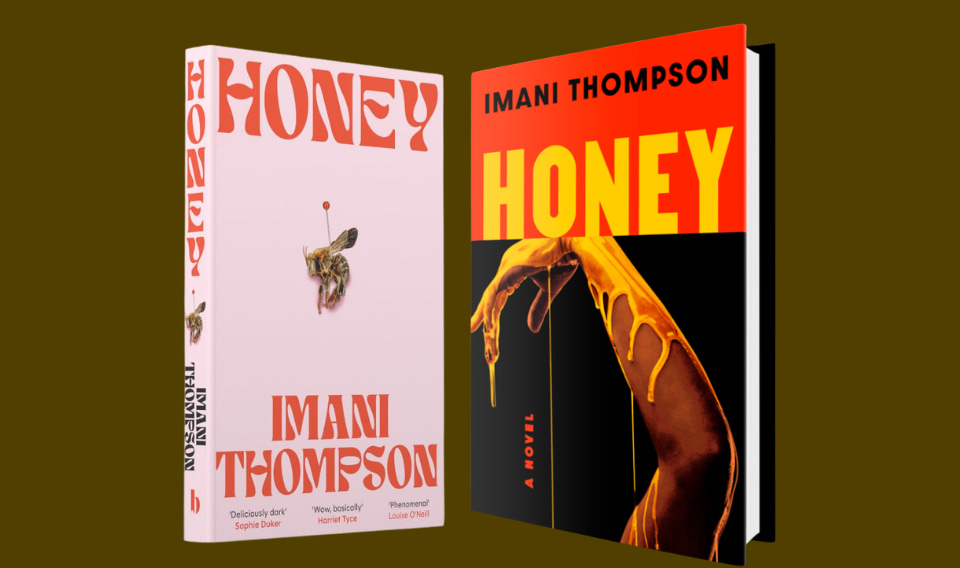
When you look at the cover alongside the book, I feel like it actually helps tell the story. What was the process of selecting it?
Thankfully, I really like both the US and the UK covers, because I was very stressed about it. I’m an aesthetically driven person, and I thought, if I don’t like my cover, what am I going to do? They sent me the US cover quite a few weeks before the UK one. I thought it was really strong. I liked that it had a kind of 70s vibe. My only note was whether the colors captured the novel’s lighter side, but I trusted the designers completely. What’s been fascinating is seeing the translation covers and how different markets interpret the book visually. When I show the US and UK covers to Brits and Americans, Americans always prefer the American one, which tells you the designers knew what they were doing.
Because so much of what I write about is the intersection of books and music, I noticed the Cleo Sol mention and the Destiny’s Child moment. Was there music you were listening to while you were writing?
Yes. I actually have a playlist I made while writing that I can send you. I do this for every book. Both my novels have completely different playlists, and I listen while I work.
Music is essential to how I write, because my writing is so rooted in rhythm. Music is the closest thing to the texture I’m trying to create in a scene or across the novel as a whole. If I’m stuck, I’ll put music on loud and dance around my house, and then come back to the page. It helps me get out of my own head and hear what the story wants.
If you had to name one song or album as the core sound of Honey, what would it be?
There’s a song I heard recently where I thought, “This is the most Yrsa song I’ve ever heard, but I can’t put it on the playlist because it’s too explicit.” It’s by a musician called Imani Coppola, who I’m named after. I feel like that song is very Yrsa-coded, but I won’t be promoting it anywhere.
From the actual playlist, I listened to a lot of Nina Simone. And the Billie Holiday album Trav’Lin’ Light, that’s mentioned in the book. Those tapped into the maternal line and the novel’s spiritual core. And then Beyoncé’s “Pure Honey” was a significant one.
There’s also an artist I discovered recently, Kirby, and she has a song called “Reparations,” where I thought, yes, that’s exactly what Yrsa is doing. During our title conversations, I even floated “Reparations” as a possible title, jokingly. They were not going with that.


I read that you were moodboarding with Danielle McKinney’s work. I could absolutely see parts of the book in her paintings.
Yes. And now I’m thinking if I mention Danielle McKinney enough, maybe one day she’ll paint something for me. Her work is so beautiful. I watch a novel like a movie in my head as I write, so visual cues are really helpful. I use Pinterest a lot for moodboarding. With the book I’m writing now, I sometimes go back to those boards and get direct ideas for scenes. I also try to go to exhibitions, watch films, and constantly feed the imagination.
You describe your writing process as spiritual. How much does that shape how you work?
It’s hard to articulate, because it’s not spirituality in a traditional sense. The concept for Honey was strategic. I thought about how to write something that could get published. But once I had that, I had to get out of my own way.
It feels like a spiritual practice because I’m tapping into something I can’t fully explain. I have to listen. That’s why I rely on music, why I move around, why I try to get out of my own head. I’m trying to hear what the story needs.
And I think if it comes to you that way, it’s easier to sustain than trying to force it.
Yes. But I also believe deeply in craft. You have to read. You have to study. You have to understand how books work. When that discipline meets the more intuitive side, that’s when something really strong can happen.
Can you tell us anything about the second book?
It’s quite different. There’s less dialogue and more focus on prose, and it’s written in first person, which has been really enjoyable. In some ways, I feel more comfortable with it because there’s less plotting. But I always want to push myself and try something new with form. What’s strange is that I’ve already written another book, but it might be years before anyone reads it. In a world that moves so quickly, publishing is still very slow.
In case you want to sit with a little more from Imani, here are a few moments from the rapid fire portion of our conversation:
On the book that made her a writer: Noughts and Crosses by Malorie Blackman. It was read to her as a child and flipped the racial hierarchy in a way that stayed with her. “As a young kid it made me go… and then you look at the shops and realize there are only pink plasters available here.”
On books she loves: One Hundred Years of Solitude by Gabriel García Márquez, which she described as “like reading in a hurricane,” and Beloved by Toni Morrison, which she read recently and found incredible.
On her ideal reading day: Sun out in London, a park nearby, snacks, and friends arriving. “We’ve come alive again.”
On social media: She apologized in advance for being slow to reply on Instagram, then asked, “Can we imagine George Orwell having to do TikTok reels?” No. We cannot.
Such an interesting interview. The book has been added to my list! I can't wait to read!
brilliant. ordered.